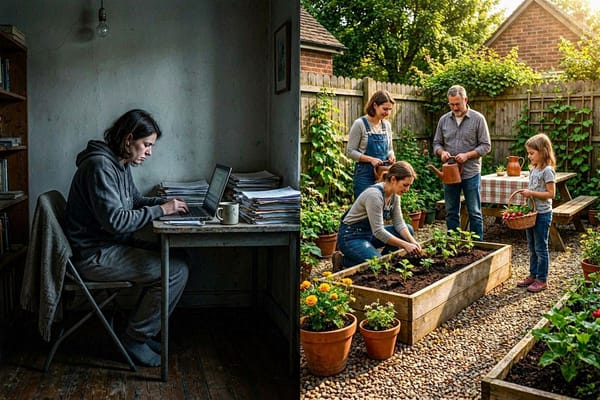
Why I left NASA to radically improve my life
We were born into a life of isolation and competition — and call it normal. After leaving NASA and living in an intentional community, I discovered something that changed everything: cooperation doesn't just make life easier. It makes it better. Here's how.

What does it mean to live well? How can we make sure that when we reach old age and look back, we're satisfied with the life we've lived?
I set out to answer that question. In this post, I'll cover three things:
- the invisible pattern making modern life exhausting
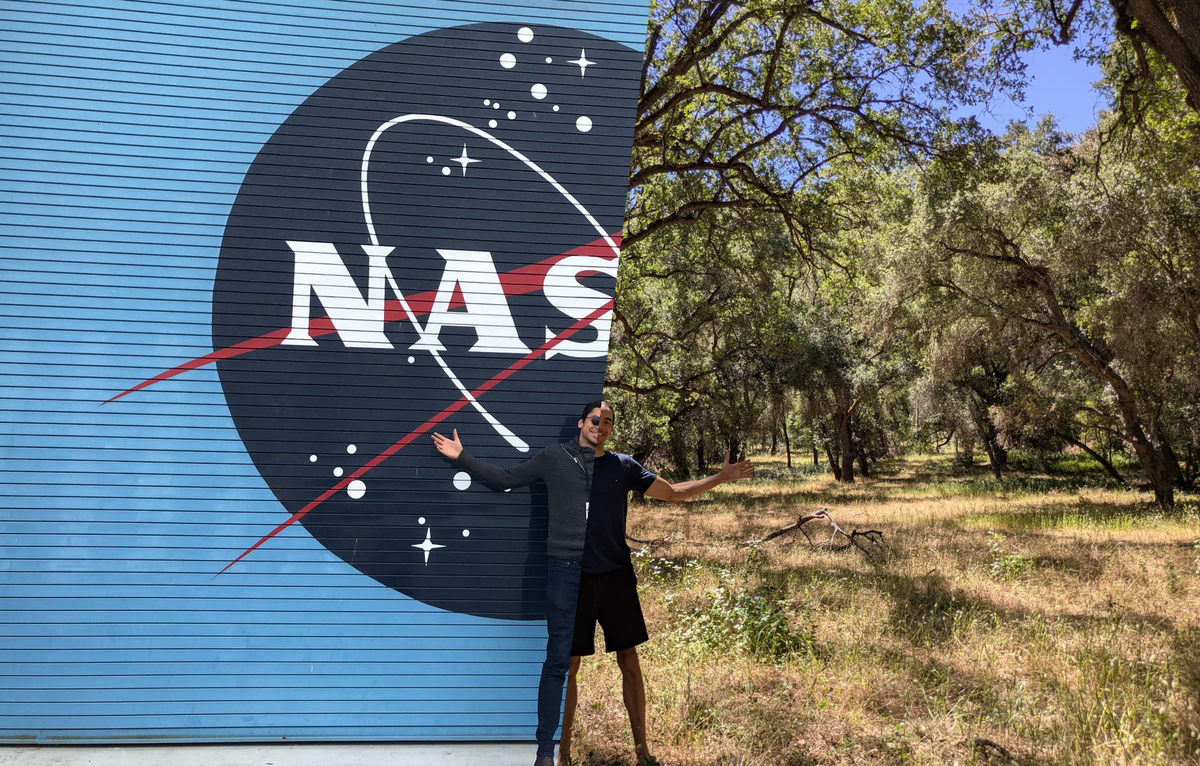
- why I left NASA to find a better way, and
- what I learned living in an intentional community in Hawaii that completely changed how I think about work, connection, and what a good life actually looks like.
Part 1: The pattern
As a kid, I thought humanity had things basically figured out. We were civilized, rational beings, and after thousands of years of civilization, our systems and institutions had been honed to near-perfection, needing only minor tweaks.
Boy, was I in for a surprise.
As I got older, I saw the cracks. I thought the courts would always find justice — then I watched people with money and better lawyers win, and the clearly guilty walk away scot-free. I thought government was for the people, by the people — then I watched corporations lobby for what they wanted at the people's expense, and governments elsewhere torture and kill their own citizens for speaking out. I thought humanity was headed toward prosperity — and now I honestly can't say it is. In many ways, the past fifteen years have gotten worse.
We don't have it figured out. Not remotely. We're floundering as a species — still at war killing each other, still manipulating each other, still allowing billions to suffer while a tiny percentage live lavishly and most of the globalized world looks away.
What I've come to discover is a core pattern at the root of nearly all these failures — a pattern so deeply enmeshed in our culture that we accept it without question, never realizing it's the very thing drowning us.
I call it atomistic individualism: the idea that each of us should operate as a discrete unit, focused on ourselves first, with everything else secondary.
This is the great mistake of modern civilization. It has a rich history I'll get into another time, but the broad pattern goes like this:
- From a young age, we spend most of our time away from home — at school, chasing grades for ourselves, competing on sports teams, math team, debate team.
- All of that so we can compete for a spot at a top university — again away from home, family, and friends.
- The university and the degrees set us up to compete yet again for the best jobs. Made new friends in college? See you later — I'm off to my job over here now.
- Then it's endless competition for promotions and more money, working our lives away until retirement.
- Along the way, many of us find a partner, marry, have kids — and teach our kids this same pattern: a life focused on oneself, in competition with others, largely in isolation.
Step back and it's almost diabolical. If I were a villain trying to trick a population into slaving their lives away for corporations, I'm not sure I could design anything better.
We play along because it's the world we were born into — it's all we know. And we're teased with a carrot on a stick: work hard enough and you can make it to the top yourself. But for most people it's a pipe dream. What's realistic is getting reasonably comfortable — if you're willing to work your life away and trade away connection to everyone you care about.
Worse, it doesn't even feel like a trade, because many of us never developed deep connection in the first place — we were always too focused on ourselves. That was true of me, too. What I once thought was closeness with friends and family I now see was surface-level compared to what I know is possible.
And that holds even if you live under the same roof. Sure, we hang out, and some people do grow close. But on a deep level we remain separate, each absorbed in our own life.
Honestly — how much time do you actually spend with the people you love? With your siblings, your kids, your partner? With your closest friends? Once a week? Once a month? Do you even have someone you'd call a close friend?
The truth is we barely spend time with the people closest to us. Mom and Dad work separate jobs, apart from each other all day. The kids are at school, then practice, then an after-school program. Everyone converges for maybe thirty minutes at dinner — possibly not even paying attention to each other — then scatters again: homework, chores, errands. By day's end everyone's tired and just wants to watch their own show and go to bed.
Rinse and repeat, and before you know it, your siblings have moved away for work, your kids are off following the same pattern themselves.
It's tragic, this story we've told ourselves — one that keeps us isolated from the people we care about, and treats whatever connection we do build as secondary to work. Offered a higher-paying job in another city, most of us take it rather than stay close to family and friends.
Think about that. We prioritize work and money over the people we love — usually for a job we don't even care about, just a paycheck — and nobody bats an eye. That's how normalized it's become.
How much we work
Then there's the other dark side of our work culture: the sheer quantity. Eight of every twenty-four hours, not counting the commute, five days a week, for most of our lives — spent, let's be honest, on things most of us don't care about. You're considered lucky if you landed work you're passionate about. And plenty of jobs don't meaningfully add anything to society at all — I can't count how many people have admitted that to me about their own work.
And what's it all for? To pay the bills that keep us trapped in the system. To buy the next gadget that satisfies for a week. To afford a few weeks of vacation a year, if we're lucky. Add the work of maintaining a life on top of the job itself, and we barely have time for ourselves — let alone for the people we care about.
The consequences
This individualist ideology is the foundation of modern global society. Whether you're German, American, or Japanese, you follow this pattern, and it's been dominant for centuries. So if you want to know what it produces, just look around.
Widespread poverty and inequality. Epidemics of mental illness and obesity. Crime, rising authoritarianism, unchecked environmental destruction, ongoing manipulation and exploitation. I'd argue all of these trace back to the same root — and I'll make that case issue-by-issue in future posts — but here's the summary version.
When civilization is structured as billions of people acting independently toward their own self-interest, we lose the ability to meaningfully address collective and long-term needs.
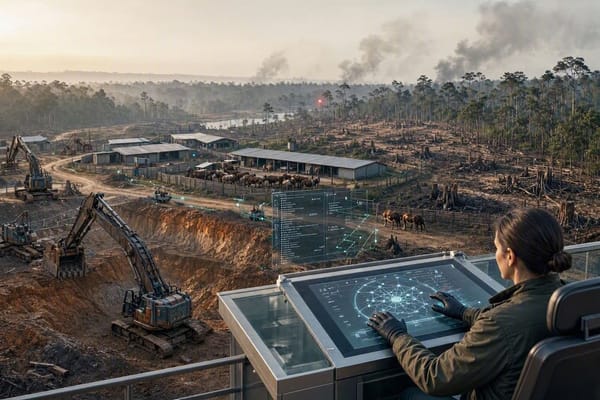
Take the climate. By now most of us know we're slowly destroying our planet. Human activity is changing the climate, leveling rainforests for cattle ranches, filling the world — and our bodies — with plastic. We are degrading the very thing that sustains us.
So what are we actually doing about it? Very little. Because with everyone acting independently, we lack the capacity for meaningful collective, long-term coordination.
It's like putting a hundred different species of insects in an ant farm, each with its own patterns, and expecting a flourishing colony. A bunch of individuals acting independently doesn't reliably produce collective flourishing.
I think many people see all this. But most carry on, resigned to the way things are.
Here's the thing: you don't have to be resigned. There is a solution — and next I'll tell you how I found it.
Part 2: Why I left NASA
I didn't have the easiest start in life. By the time I was five, my father was in jail and my mother was deeply addicted to drugs — the bad stuff, the kind that hospitalized her more than once. We were very poor.
I have a vivid memory of my mother, my brother, and me sharing a single boiled potato for dinner. I wanted french fries so badly — there was a billboard near our house with a picture of McDonald's fries that I saw almost every day. I put ketchup on my portion of potato, because that was the closest I could get.
Eventually, DSS intervened. My mother was ordered to a series of visits with a social worker to prove she still wanted to be our mother. She showed up wasted the first time, and they turned her away. Wasted the second time — turned away again. The third time, she never showed up at all.
I never saw my mother again.
My brother and I were placed in a foster home. I was six — just a kid doing what the big people around me said. I'm grateful for the care I was given, and it was a gift to leave dinner with a full belly. But my foster family had kids of their own and ran a daycare, so individual attention was scarce. I could watch all the TV I wanted, play all the video games I wanted, wander the woods or into town as I pleased. I was taken care of. I'm not sure I felt loved.
Except by my brother, who has always been there for me.
Every kid in foster care hopes to be adopted by loving parents, and the odds shrink as you get older — most adoptive parents want young children. But at nine, my brother and I were both adopted by a well-to-do, Harvard-educated couple in a nearby upper-middle-class town.
What a reversal. Where once I'd had almost no attention, now everything I did was scrutinized. Swim lessons, taekwondo, summer camp, Goosebumps, Redwall — read, read, read. This was the '90s and early 2000s, when the prevailing mood was that civilization was headed toward prosperity and America was the place to be. I was filled with hope for the future.
My adoptive parents prepared me for success the best way they knew — the same pattern they had learned. And I followed it. I went to university, got a job at the U.S. DOT, met the right people, made the right impressions, and ultimately landed a coveted job at NASA.
By every standard measure, I had made it: a prestigious career, good pay, job security — even work that served the common good. For years, life was great.
But when you're focused entirely on your own life, it's easy to miss what's happening around you. When your head's in a textbook, when you're grinding for the next promotion, that's all you have attention for. I get it. I was that way too.
As the years passed and I grew comfortable, I finally had the spaciousness to look up — and I saw people struggling. Corporations posting record profits while most Americans lived paycheck to paycheck. My brother and sister cycling in and out of debt. A world drowning in problems that weren't going away on their own.
Having come from hardship, I knew what it was like to have less. I started reflecting on the contribution I was actually making. Sure, airplanes flew more safely and efficiently because of my work — but was that the priority when so many people couldn't meet basic needs? I could donate to charity, but would that really change anything in the long run?
It seemed like there was a deeper problem with how life itself is structured — and I felt increasingly unfulfilled working on problems so removed from the average person's needs.
So I left.
And I went looking for answers to three questions:
- What actually brings people happiness and fulfillment?
- How do we create a world where, instead of everyone acting independently, people work together for the common good?
- And if we did — if people genuinely weighed collective needs alongside their own — could we still individually flourish? Is there even a difference between collective flourishing and individual flourishing?
As a scientist, my natural process is research. I read countless books, studies, and articles, and it turns out science has a pretty good answer to the first question. Happiness and fulfillment come down to a small handful of things:
1. Deep connections with family and friends. The evidence here is extensive: the quality of your relationships plays an enormous role in how satisfied you are with your life — and I've come to believe most of us underestimate how deep connection can actually go. I'll share much more in future posts about how to nurture that kind of connection.
2. Meaningful work, balanced with relaxation and play. Even in a world where robots did all the labor, people would still work — putting your energy toward something meaningful is a near-universal human need. But it has to be balanced with real time for rest and play. The ideal is getting all three at once, like a chef who's genuinely energized by cooking for people — it's almost therapeutic — while staying playful and experimental in the kitchen. Short of that ideal, the bottom line is: people need to work on what's meaningful to them, with enough time left for everything else that brings them joy.
3. Living in alignment with your values.
If you value protecting the environment, but everything you buy comes wrapped in single-use plastic and your home runs on coal power — that's living out of alignment.
If you value deep connection, but your friendships never go past surface-level chit-chat — out of alignment.
If you value eating well, but you work so much you end up with fast food most nights — out of alignment.
Identifying your values and living by them creates coherence. Living against them creates dissonance — and, ultimately, dissatisfaction.
So: if we know what leads to fulfillment, how do we actually get it?
You can't build deep connections if all your friends are consumed by work and never learned how to connect deeply. You can't do meaningful work if you can't land the job you want — and even if you do, the work-life balance probably won't be healthy or sustainable. And you can't live by your values inside a society that won't accommodate them. If your town doesn't even offer composting or recycling, you're left fighting that battle alone.
I didn't know how to resolve all this at first. Then, in my research, I came across the idea of intentional community: a group of people who come together to live by their shared values, on the premise that cooperative living produces a higher quality of life than the individualist default.
It's not a new idea. It's the original idea. Humans lived communally for nearly all of our history — hundreds of thousands of years — until the industrial revolution and the centuries around it shifted us toward independence.
So I decided to test it myself. Does intentional community really lead to a better life? I found a community in Hawaii, got on a plane, and what I discovered was eye-opening.
There's a lot to say about those two years, and I'll weave the details into future posts, but here's the nutshell:
- It's possible to have modern amenities and comforts while working only a handful of hours per week — potentially even less with the right systems. The idea that a comfortable life requires 40 hours of work a week is simply false.
- There's a deeper way to connect — with yourself, with others, with the environment around you — than most of us in the modern developed world have ever experienced. Once you understand it, your relationships are never the same. More on this soon.
- Every community is unique. Just as every person is unique, every group is unique — and how a group structures itself, shares power, and makes decisions shapes the entire way of life it creates.
Part 3: Finding happiness and fulfillment
After two years, I returned stateside with lived proof that the basic premise works: cooperative living creates a more easeful, more affordable, more connected, more fulfilling life.
The reason comes down to one simple truth: cooperation creates synergy.
Where individualism produces gross inefficiency — no shared plan, endlessly duplicated effort — cooperation produces remarkable efficiency. Imagine a company where every employee worked on their own thing with zero coordination. It would be a disaster. The whole reason organizations succeed is that people align on shared goals and work together. The same logic applies to the work of living itself.
Synergy is the phenomenon where a group working together produces more than the sum of what its members could produce alone. Put five people on five separate one-acre lots, each building their own home, power system, plumbing, and garden, and they'll work hard and not get very far — some will fail and give up. Put those same five people on one five-acre parcel working together, and they get much farther, much faster. Not five times faster — potentially ten times or more.
The numbers are illustrative, but the mechanisms are real:
- Economies of scale — one person can make soup for ten with minimal added effort over making it for one.
- Elimination of duplicated effort.
- Better decisions — more people means more knowledge, more experience, and wisdom-of-the-crowd effects.
A quick caveat: any group's success depends on who's in it and how it's organized. Most of us have suffered through a school group project where a few people did all the work and the whole thing was chaos. I suspect a lot of people walked away believing groups are worse than going it alone. But a random group of untrained kids was never going to work well together. Teamwork is a skill, and like any skill, it has to be practiced. With the right people and the right structure, a group can be incredibly efficient — and that efficiency translates directly into ease for everyone involved.
A concrete example. The Hawaii community averaged about twenty people. Instead of twenty individual dinners every night, teams of two or three cooked for everyone — meaning each of us cooked just one night per week. If you cook, you know the full weight of it: shopping, prep, cooking, cleanup. Imagine doing all that once a week, yet enjoying a home-cooked meal — from a rotating variety of styles and traditions — every single night. What luxury! And the savings compound: one or two giant pots instead of twenty cold pans heated separately, a few large dishes to wash instead of twenty sets of cookware. Less energy, less water, less time.
You can apply this to everything a life requires.
Vehicles. Twenty individuals would own twenty cars. Because our work was invested in the community itself rather than jobs in town, we needed only two or three, managed with a simple sign-up sheet — and it worked great. Even needing four or five, that's fifteen fewer vehicles. That money can buy nicer vehicles, or fund other parts of the community — and a better variety: an EV for local trips, a minivan, a truck, a jeep for adventures, even a bus for whole-community outings. And with specific people managing the fleet, you never think about car maintenance again. Imagine that.
Groceries. Instead of twenty people separately driving, parking, hunting down items, and waiting in line, one or two people shop for everyone. Grabbing four bags of apples instead of one is barely more work — and it frees nineteen people from the errand entirely.
Laundry. Twenty independent households means twenty washers and dryers, most sitting idle. A community needs a handful of nicer machines running on a smart schedule, with one or two people handling loads and delivering them back. And if you're particular about your laundry — you want the settings just right, or you'd rather grandma not fold your underwear — do it yourself! Nobody's forcing anything. The point is that whatever tasks you're willing to entrust to others, community makes possible.
Logistics. Need your kid dropped at soccer practice? In a community of twenty, odds are someone's already heading to town and happy to take them.
I could go on, but you see the shape of it. Cooperative living dramatically reduces everyone's workload. Each person does one or two things for the whole group, spends modestly more time on them than they would alone — and in exchange, nearly all their other time is freed. I witnessed this firsthand. It isn't theoretical; it's happening right now in thousands of communities worldwide.
How much work is there when work is shared?
The honest answer: it depends — on the community's stage and its structure.
If you're building a community, as I am, there's far more work than joining an established one with infrastructure and systems already in place. The trade-off is that builders get to shape everything to align with their values, rather than fitting themselves into someone else's vision.
In Hawaii, each person was expected to contribute about ten hours a week: one dinner shift, an hour or two on weekly cleaning day, and the rest wherever you chose — gardening, grocery runs, building projects, repairs.
That's already a massive improvement over what most people spend maintaining their lives today. Imagine maintaining — no, continuously improving — your quality of life on ten hours a week. But honestly, I think we can do much better. Five hours is easily achievable, and with the right people, you can approach zero.
Here's why. There's a crucial distinction between work you want to do and work you don't. When I talk about "work" in community, I mean the second kind.
Every community — like every household, every society — has a set of things that simply must happen: cooking, cleaning, gardening, shopping, maintenance, construction, taxes, trash. The trick is matching those tasks to people's passions — at which point they stop being "work."
Take a chef. Someone genuinely passionate about cooking isn't going to be satisfied with one dinner a week. They won't cook every day, and some weeks more than others, but people don't ration the things they love. Same with a true gardener — a few hours a week won't be enough for them; they'll be out there constantly because they want to be.
So: match the necessary work to people's passions first. Whatever remains unclaimed, the group decides together how to divide — split the hours evenly, pay someone, whatever your group agrees on. But ideally, you recruit for the gaps, ensuring every recurring task has a few people who genuinely enjoy it. And trust me — there are people passionate about every task you can imagine. People who love cleaning. People who love doing taxes. You just have to find them.
There are also people who simply don't mind pitching in — several in the Hawaii community, myself included. I'm content to do whatever no one else wants to, because if it needs doing, it needs doing — and it's in service of the people around you, the people who eventually become your family. That fulfills me. That's not license to dump the undesirable work on the willing few — but between passion-matching, volunteers, and fairly splitting the remainder, most people end up with little or no work beyond what they love, if the community is designed and recruited well.
And there's a bonus: shared costs mean both the quantity and quality of what you have access to goes way up. Five excellent vehicles instead of twenty average ones. A few top-tier washers instead of twenty. One or two swimming pools. Twenty people pooling resources can build beautiful homes, a gym, a sauna, a home theater — far beyond what any one of them could afford alone.
This is the power of synergy and cooperative living. And it's just the tip of the iceberg. The gains compound — with enough people (30, 50, 100) and good automation and systems design, we can create a life where most people don't have to work at all if they don't want to. It is absolutely within reach.
And here's the key: with all that time and energy reclaimed, we're free to spend our lives on what fulfills us. It's not about working less for its own sake. It's about having the space to be close to the people we care about, to do work that matters, and to live in a way that aligns with what we believe. That's what intentional community gave me. And it's what I'm building now, for anyone willing to join the journey.
These ideas naturally raise more questions:
- How do you make sure work is distributed equitably?
- How do you make decisions together?
- What's the ideal community size?
- How do you decide who joins?
These are rich topics that deserve their own posts and videos, so stay tuned to this blog and my social channels. I'll keep making the case that it's absolutely possible to live a more easeful, more affordable, more connected, more fulfilled life — by living